
MSc People and Organisational Development
Discounted Early Booking Fees Currently Available
A Masters in Organisational Development Delivered Internationally, Online.
Overview
Roffey Park’s MSc in People and Organisational Development is an established, internationally recognised master’s qualification designed as a practical and experiential OD qualification. The programme is delivered through a mixture of virtually taught components, online materials and self-directed group learning. The latter takes the form of Dialogic Learning Groups in which learners work together, share their experiences, provide each other with feedback and expand their horizons. This form of social learning has been a speciality of Roffey Park Institute for many years and offers a powerful and impactful learning experience. Throughout the master’s in organisational development you will be challenged to think critically and creatively about organisations, their people and their role in the wider society.
The programme is delivered entirely online to international cohorts creating global networking opportunities for experienced OD professionals with diversity of opinions and perspectives.
We are a partner institution of the University of Sussex who act as the validating authority for our MSc in People and Organisational Development.
Who is this
programme for?
- An HR professional wanting to deepen your practical skillset in organisational development
- A learning and development and talent manager looking to interpret the requirements of culture change and organisational transformation
- A transformation officer/CTO/change lead looking for the maximum guarantee of project success
- A CEO or senior director/partner in need of the full picture of the organisational change process
- An independent or internal consultant in organisation development and change, now or in the future

Benefits for you and your organisation
- Demonstrate a thorough knowledge of organisational development (OD) theory and its evolution, and critically evaluate different OD models, tools and techniques
- Apply OD concepts to real world situations and demonstrate an understanding of the role of OD in organisational success
- Analyse change dynamics within an organisation and lead the application of group dynamics and dialogic methods as key OD tools
- Reflect on your own OD practice, identify areas for improvement and demonstrate evidence of a commitment to on-going learning and continuous improvement
- Function as an OD professional with a critical appreciation of how equality, diversity, inclusion and sustainability impact on the practice of OD
- Develop and critically evaluate plans for OD interventions that address organisational challenges
- The Dissertation provides an opportunity to conduct real-world research in the field of OD for your organisation
- Build an international network of OD contacts
Programme Outline
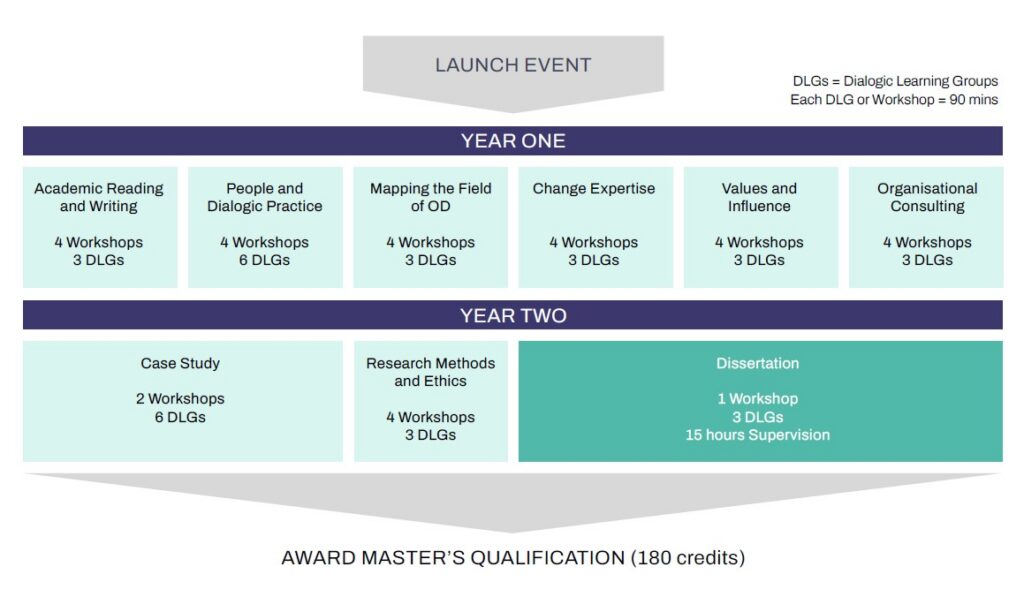
The modules you’ll complete on this course are:
This module is intended to provide learners with baseline skills and understanding of the reading and writing requirements of the course.
This module introduces the learners to the principles of dialogic practice and the specific function of the Dialogic Learning Group in developing practical and applicable strategies.
This module introduces learners to the history and development of organisational development in theory and practice. It examines what OD brings to the world of work and analyses the underpinning values and key characteristics that inform OD practice.
This module analyses and explores the significance of change expertise in the development of effective OD solutions. It introduces learners to the psychology of change and considers how to manage the response of people in organisations to transformations brought about by internal and external drivers.
This module explores the importance of values and influence in developing OD solutions. Values are explored from a number of perspectives.
This module explores a number of dimensions of organisational consulting in the analysis, design and delivery of development interventions across multiple functions within an organisation.
This module requires each learner to develop an extensive reflective case study of an organisational development process (either in their own organisation or in another by research).
This module prepares learners for their dissertation by outlining and practicing key research methods. Learners will explore ideas for their research and consider different research traditions/methodologies. The module also covers the research ethics process.
The course concludes with the dissertation module in which learners will work independently, supported by a supervisor and with formative support through their DLG, to produce their dissertation. The dissertation includes original research within the cognate area of the programme based on a workplace context.
Course Fees
Course fees are fully inclusive of all the resources and learning materials you’ll need.
For self-funding students an interest-free 24-month payment plan is available. Contact us for further details
Standard Rate: £12,500*
Early Booking Rate £12,000*
* Plus VAT where applicable
Join our next webinar
Roffey Park’s MSc in People and Organisational Development provides a rich learning
experience like no other. You will walk away with a Masters qualification and the knowledge to transform people and their organisations. Moreover, you will have spent two years learning alongside an international cohort of OD practitioners and faculty team.
Roffey Park will be hosting a complimentary webinar for those interested in enrolling on this course. We will provide an overview of the course and our unique approach to learning. You will have the opportunity to meet members of our faculty team and ask further questions about the course itself. At the end you will have enough information to start your application to join our MSc.
Entry Requirements
Applicants are normally expected to hold at least a 2.2 UK bachelor’s degree (or international equivalent) and have a minimum of four years’ relevant professional experience.
We also welcome applicants who do not fully meet these criteria. We take a holistic view, assessing suitability based on qualifications, experience and evidence of ongoing personal development. The application form requests career and qualification history plus a short statement on what you hope to gain from the programme. All applicants attend an online interview before an offer is made.
The programme is taught entirely in internationally accessible English. If English is not your first language, you will need a minimum IELTS score of 6.5.